BRAHMAPURI, June 7: The demand for a caste-wise census of the Other Backward Classes (OBCs) is gaining momentum across Maharashtra, with the National OBC Mahasangh intensifying its agitation against what it describes as the government's continued neglect of the OBC community. The organization has announced a massive protest march (Mahamorcha) to be held in Chandrapur on June 28, aimed at pressing for the inclusion of a separate OBC category in the ongoing national Census process and addressing other issues affecting reserved category communities.
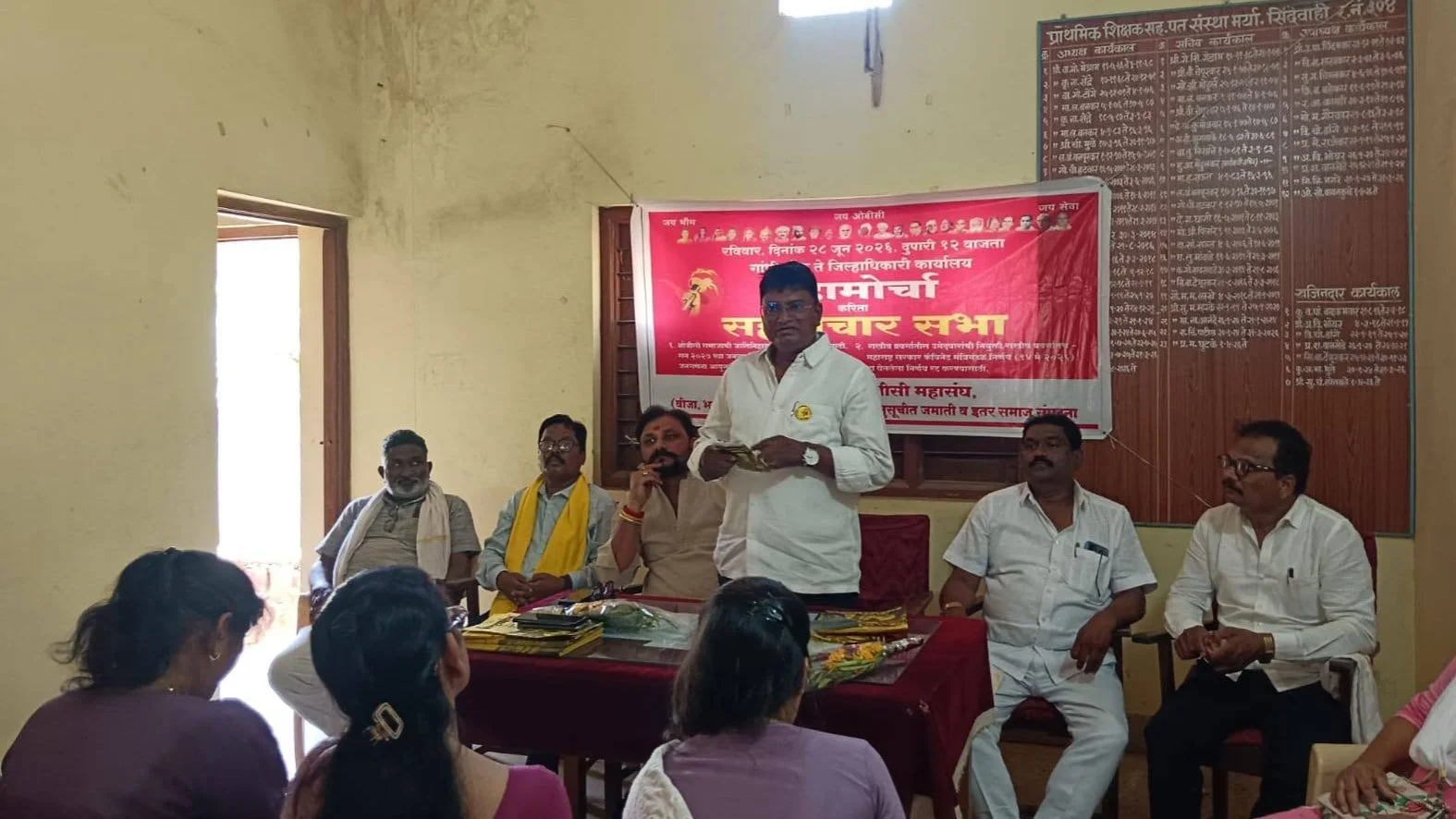
Addressing the gathering, Sachin Rajurkar, National General Secretary of the OBC Mahasangh, strongly criticized the government's approach to the Census process. He asserted that the current Census framework is fundamentally unjust to OBC communities because it does not provide a separate column for OBC identification.
Rajurkar pointed out that the government had previously assured citizens that a caste-based census would be conducted. However, despite those commitments, no effective steps have been taken to ensure that OBC communities are counted separately.
“The government has repeatedly spoken about social justice and equitable representation, but without a dedicated OBC column in the Census, these promises remain hollow. A caste-wise census is essential for understanding the actual demographic strength of OBC communities. Until the government issues an official Gazette notification ensuring a comprehensive OBC caste census, our struggle will continue,” he declared.
The June 28 Mahamorcha is expected to draw thousands of participants from various districts of the Vidarbha region. Organizers believe the protest will become a significant milestone in the ongoing movement for OBC rights and representation.
Apart from demanding a caste-wise census, the Mahasangh is also opposing the Government Resolution (GR) issued on May 14, 2026, concerning recruitment procedures for reserved category candidates. The organization argues that the resolution adversely affects opportunities available to backward-class communities and requires immediate review and withdrawal.
Several prominent leaders attended the meeting as chief guests, including former Zilla Parishad member Pramod Chimurkar, social activist Vinod Zhodge, Krishna Masram, District President of Adivasi Vikas Parishad, social activist Jaideep Rode, Ravindra Pilare, President of the OBC Employees Federation, and Alka Khokle, Women's President of the OBC Mahasangh.
Speaking on the occasion, Pramod Chimurkar emphasized the need for unity among OBC communities. He called upon youth, students, and social organizations to actively participate in the June 28 rally.
“This is not merely a political issue; it is a question of our future generations. Young people must come forward and participate in large numbers so that our collective voice reaches the government with strength and clarity,” Chimurkar said.
Social activist Vinod Zhodge echoed similar sentiments and issued a strong warning to the authorities. He stated that the OBC community would continue its struggle until a separate column for OBCs is officially included in the Census questionnaire.
“We are determined to fight for our constitutional rights. The government cannot continue to ignore the aspirations of millions of OBC citizens. If required, we are prepared to make every sacrifice, but we will not tolerate this injustice any longer,” he asserted.
Speakers at the meeting argued that the exclusion of OBCs from a dedicated caste-counting mechanism would have serious long-term consequences. They noted that accurate population data is crucial for policy formulation, reservation benefits, educational opportunities, economic development programs, and political representation.
According to the leaders, while separate demographic data is collected for Scheduled Castes (SCs) and Scheduled Tribes (STs), the absence of a similar mechanism for OBCs creates a significant disparity. They maintained that without reliable population figures, OBC communities cannot effectively claim their fair share in government schemes, welfare programs, employment opportunities, and elected institutions.
Rajurkar further warned that if the government fails to issue an immediate Gazette notification regarding an OBC caste census, the agitation would be intensified across Maharashtra and other parts of the country. He stressed that the issue has become a matter of survival, dignity, and constitutional rights for the OBC community.
The meeting witnessed enthusiastic participation from several OBC leaders and activists, including Suresh Burade, Kewalram Maid, Tikesh Shivankar, Rahul Bhoyar, Bhaurao Raut, Mahendra Matere, Arvind Raut, Vijay Bagmare, Dilip Bawankar, Nandu Maske, Pinky Raut, Reena Thackeray, Poonam Thengre, Yogesh Dhonge, Bhaskar Sondarkar, Vilas Maid, Ravindra Pawar, Raju Kuthe, Rambhau Narad, Nayana Azbel, Pratibha Bhoyar, Yashwant Talamale, Gajanan Randive, and V.G. Randive.
Professor Ravindra Pillare delivered the introductory remarks, highlighting the importance of collective action in safeguarding the interests of backward-class communities. The proceedings were conducted by Professor Laxman Meshram, while the vote of thanks was proposed by Professor Suresh Burade.
With the June 28 Mahamorcha approaching, OBC organizations across the region have begun mobilizing support, making it clear that the demand for a caste-wise OBC census is likely to remain a major social and political issue in the coming months.